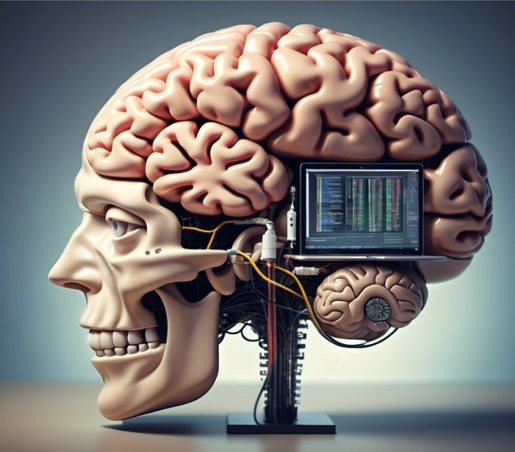
SADCOM Framework
The SADCOM methodology defines systems through metadata rather than code.
It enables interoperability, smaller cloud footprints, and environmentally efficient computing.
The Team builds the metadata framework, then every business or person just manages
their own metadata. This creates effortless interoperability between systems, business to business, person to person, and beyond.
SADCOM is an open methodology and DIY cloud provider concept, designed to help anyone operate their own self-describing,
low-impact infrastructure.
It promotes using the cloud as true IaaS - Infrastructure as a Service - thus a foundation for computation and storage.
Under this model, the cloud returns to what it was always meant to be: renting CPU, RAM, and disk remotely.
If we all spent less "cloud" on metadata-less data, we’d have so much more money and power left to truly augment our future.
SADCOM is an Open Methodology to share with all
We will teach you for free
Email SADCOM
The SADCOM Methodology
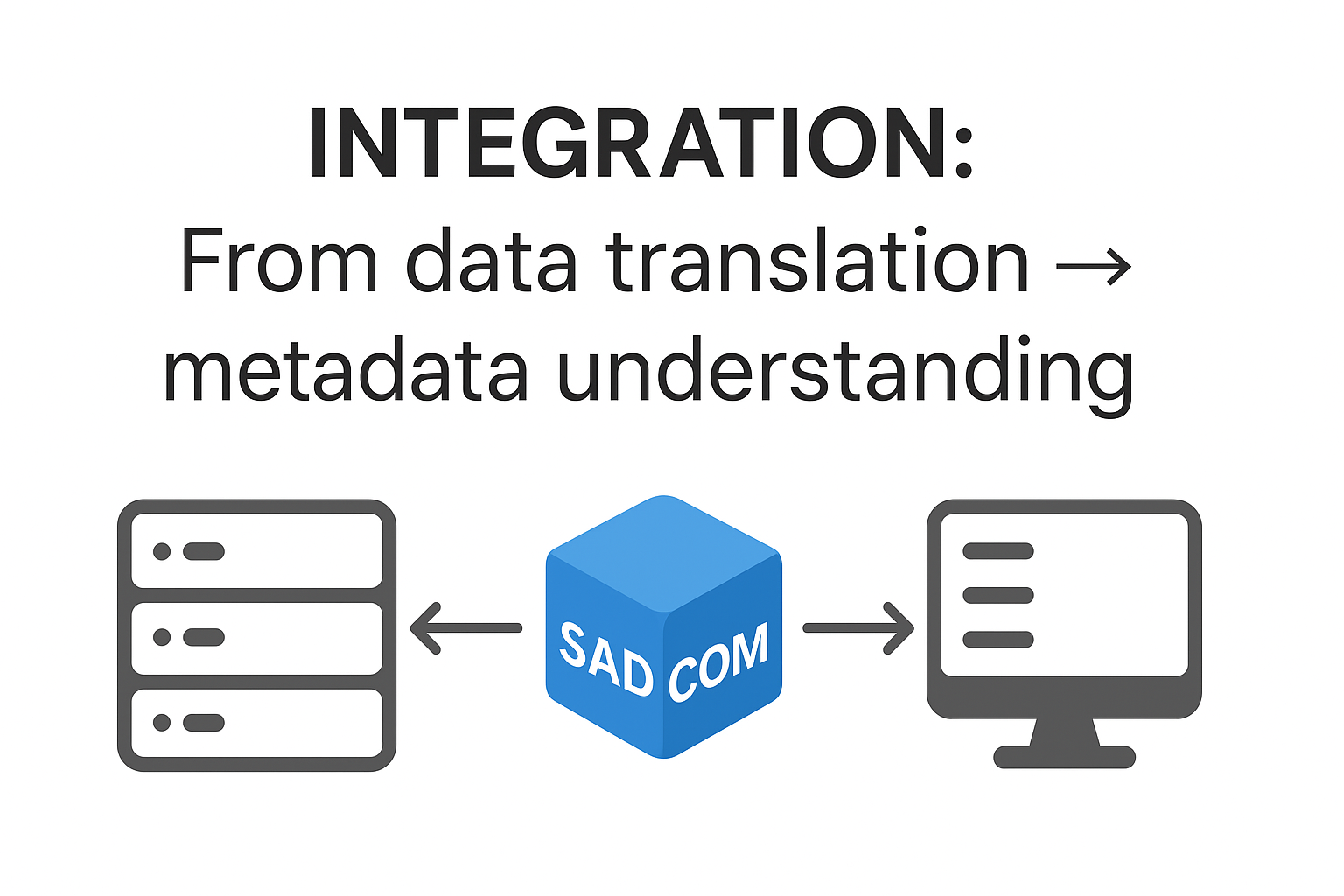
SADCOM stands for System Agnostic Design through Common Object Metadata.
It abstracts system design to metadata, not code, allowing universal interoperability across any platform or language.
Think of it as a universal grammar for systems, enabling humans and AI to communicate at the same level.
SADCOM Framework
SADCOM doesn’t replace roles it aligns them. Developers code, DBAs manage data, PMs plan, and SMEs define the metadata.
Everyone works inside one shared framework and model instead of fighting a pile of ERPs, CRMs, MDMs, and custom systems.
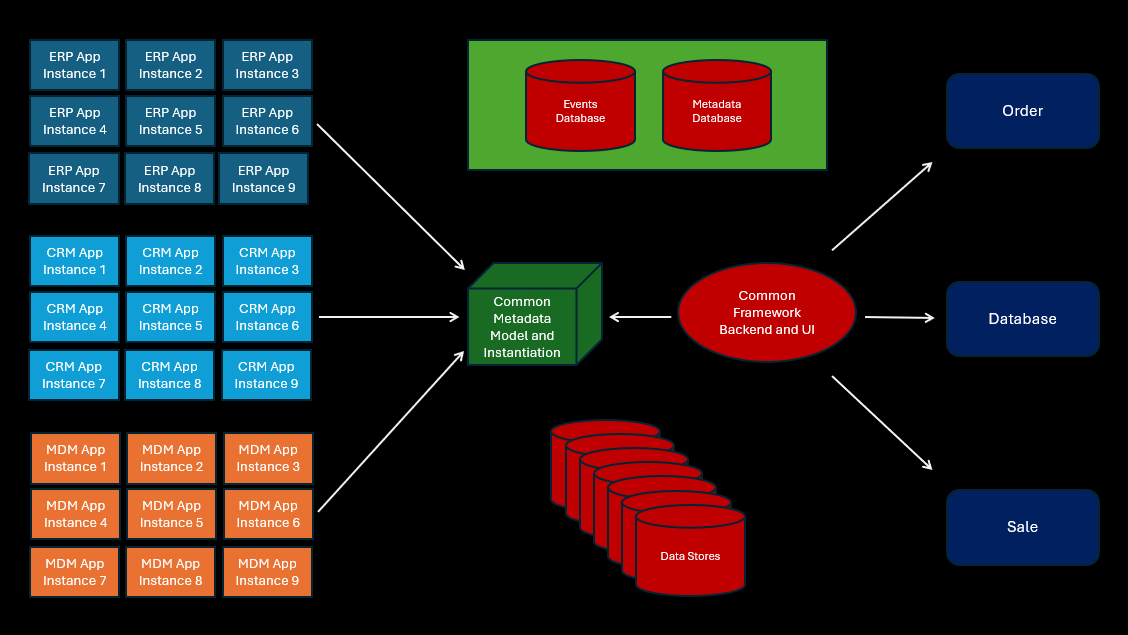
At the end of the day, all you’re really doing is renting CPU, RAM, and disk in the cloud. SADCOM ensures those resources run your business model not a tangle of redundant applications.
And because it’s completely system-agnostic, the same metadata model runs on any language, database, queue, cache, storage layer, public cloud, private cloud, or even your own hardware.
HCS - Human Computer Science
Human Computer Science (HCS) studies the human brain as an information processor and explores ways to optimize, enhance, and interface human cognition with computing systems, much like the legendary "human computers" of NASA.
HCS trains the human mind itself as the primary computer, using AI only as an augmentation layer. It builds the cognitive foundations needed for high precision reasoning, rapid processing, and mental organization at scale.
HCS is the practical union of computer science and neuroscience, where biological cognition meets engineered augmentation. And the more powerful our own mental “hardware” becomes, the less we have to lean on external compute i.e. global resources.
The discipline also explores traditional visual based training as well as auditory only brain training designed to strengthen working memory, pattern recognition, and fluid intelligence. Helping students develop the ability to process and manipulate information without relying on sight or manual input.
This lays the foundation for a future of hands free, eyes free interaction with data, where the mind becomes the main interface. The central goal of HCS is to train your brain into the high performance computer it was always meant to be.

NASA “Human Computers” - 1936
HCS 101
×
HCS 101: Training the Human Computer
In Human Computer Science (HCS) 101, we study the human brain as a computing system its CPU, RAM, and Disk and learn to optimize it for maximum cognitive performance.
Memory as RAM / Core
Your working memory acts as the brain’s RAM, handling immediate processing thinking, reasoning, problem solving, and learning. Daily exercises in the brain gym strengthen this core, improving recall, attention, and mental agility.
Brain Disk / Persistent Storage
Long-term memory functions as the brain’s Disk, storing knowledge, experiences, and skills for decades. Techniques like spaced repetition, storytelling, journaling, or mental filing systems help encode and maintain information long-term. Just as a computer relies on storage to retain critical data, humans need persistent memory to build expertise and context over a lifetime.
CPU / Central Processing
The brain’s CPU represents central processing decision making, planning, and integrating information from RAM and Disk. Optimizing the CPU involves refining attention, reasoning, and problem solving strategies.
Augmentation with Technology
Like computers using external drives or cloud storage, humans can augment memory and processing with:
- Digital note taking, spaced repetition apps, or personal knowledge management systems.
- AI assistants that help retrieve, organize, and cross reference information.
Integration of RAM, Disk, and CPU / Brain Gym
Cognitive performance peaks when RAM, Disk, and CPU interact efficiently. In HCS 101, each student learns to use the University Brain Gym to train these systems. Daily exercises strengthen memory, enhance reasoning, and optimize mental processing. All students gain access as part of their curriculum. Memory training combined with deliberate use of external tools dramatically increases mental throughput, creativity, and learning capacity.
Ultimately, HCS 101 teaches that by optimizing our own “human computer” our brain’s RAM, Disk, and CPU we unlock personal cognitive potential and advance both Computer Science and Neuroscience. Enhanced human cognition improves our ability to design better computing systems and generate deeper insights into brain function, creating a feedback loop where cognition, CSC, and NS propel each other forward.
CogniGym - The Brain Gym
All Universities have gyms for the body — why not the mind?
CogniGym is the structured “brain gym” to train RAM (working memory), CPU (reasoning), and Disk (long-term memory).
Training includes working memory drills, auditory-only processing, reasoning, pattern recognition, and cognitive endurance.
The stronger our minds, the less we rely on external compute resources.
SVX - Simple Voice Experience
SVX makes it simple for any company to build and host its own voice-enabled platform.
Extend your existing Web, Android, or iPhone apps with secure, natural voice commands no complex setup required.
No AI is required, integration takes just a few APIs, letting you expose your business logic hands and eyes free.
More than a product, SVX is a methodology for voice-enabling applications in just hours.
It uses simple, teachable grammars to deliver true voice-first usability for real-world tasks—giving you
full control over where and how your voice system runs.
Companies, creators, and individuals can learn to add voice layers to their current apps or systems,
creating inclusive, hands-free access for workers, students, and anyone on the go.
Manage your business with your voice. BizVocal ties into tools like QuickBooks and GPS to help you manage teams,
track jobs, and handle finances through simple spoken commands.
Perfect for painters, carpenters, plumbers, project managers, farmers, factory workers, engineers, and more.
It simplifies coordination, scheduling, and accountability, and can grow to include many additional use cases.
PlayVocal is an interactive, sound-only gaming and music marketplace.
Think Name that Tune or Choose Your Own Adventure meets Dungeons & Dragons, Solve a Mystery,
or Explore Space - immersive voice only content powered by top sound designers and musicians
It creates new job markets for audio creatives, offering a direct path for sound engineers and artists to
publish and monetize immersive, voice-driven experiences.
LearnVocal brings hands-free learning to life. Picture students biking to class along the Burke-Gilman Trail at UW
while studying aloud. Professors can distribute content, quizzes, and capture answers audibly in real time.
It’s also a platform for auditory brain training and immersive educational experiences, open to global
partnerships with educators and institutions.
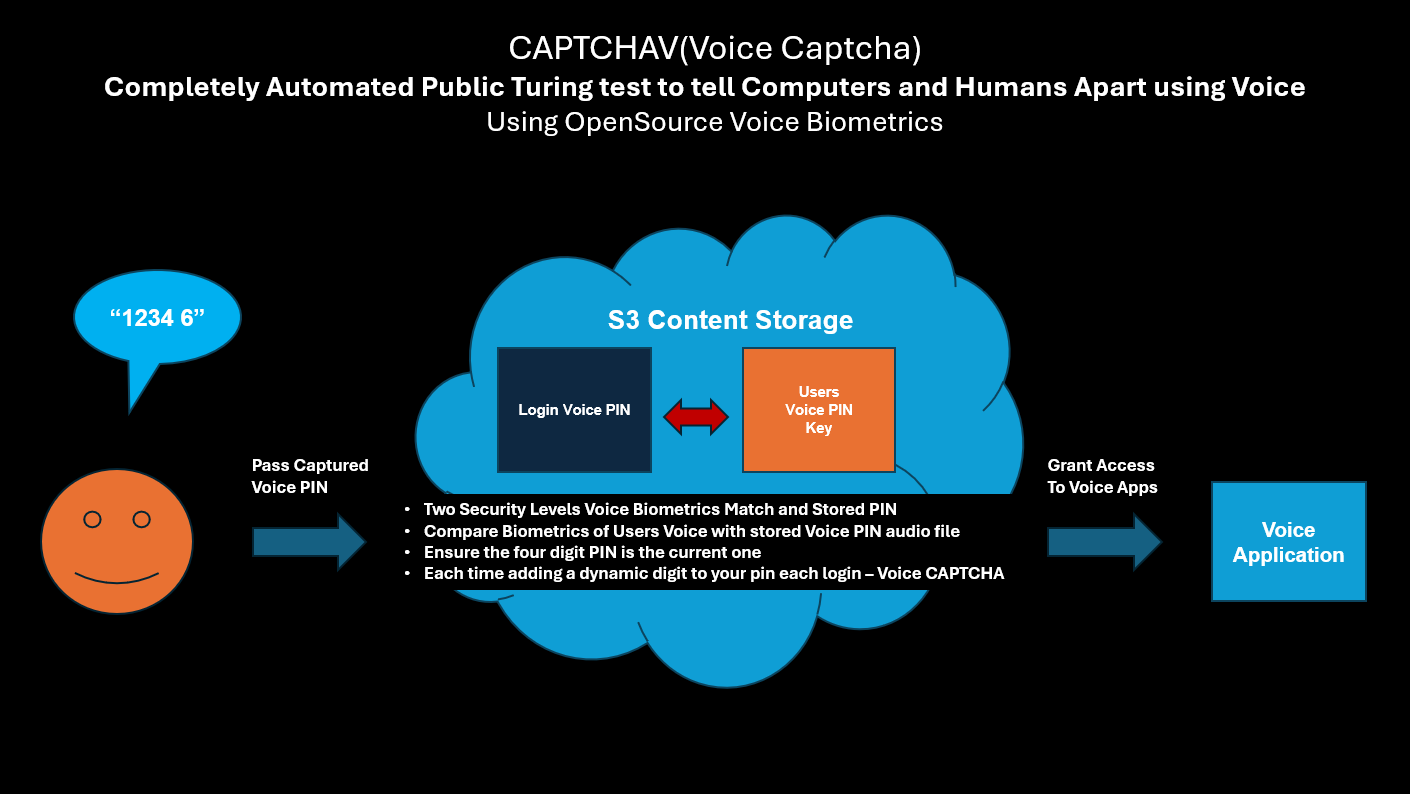
CAPTCHAV introduces voice-based verification, a secure, human-first authentication model
that combines natural interaction with identity validation.
Each login uses a dynamic voice PIN and biometric profile for authentication,
turning security into a seamless part of the experience.